CommsCloud
Why fleet connectivity drops at African borders
Understanding why fleet connectivity drops at African Borders allows you to engineer the drops in coverage out of your operation.
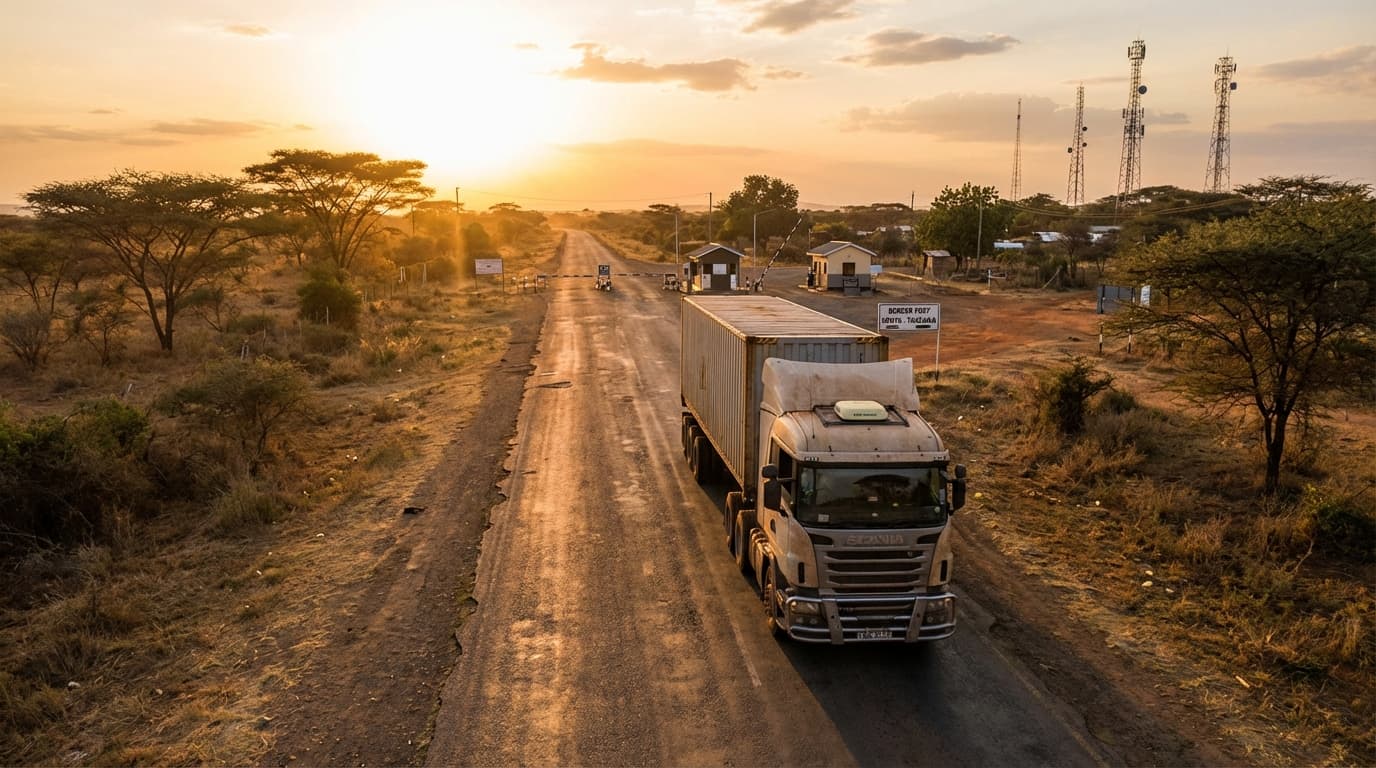
Understanding why fleet connectivity drops at African borders is the difference between reacting to outages and engineering them out of your operation. If you operate a logistics fleet across Africa, you've seen it happen.
A truck approaches a border post. Telemetry slows. Dashcam uploads stop. GPS tracking drops off the map. For a few minutes, or sometimes hours your fleet goes dark.
This isn't random. And it isn't bad luck. African border crossings expose structural weaknesses in how most mobile connectivity was designed.
When fleet connectivity drops at African borders, it exposes the issues
When a vehicle crosses a border, it enters one of the most hostile environments for mobile networks anywhere in the world.
Not because Africa lacks infrastructure but because borders are where regulation, radio engineering, and roaming architecture collide.
- Border Networks Are Engineered to Be Weak, On Purpose
As vehicles approach a national border, signal quality often degrades gradually before failing altogether. This isn't poor coverage. It's a deliberate design.
Mobile operators must prevent harmful radio interference in neighbouring countries. Regulators enforce strict field-strength limits near borders, often in bands reused on both sides.
To comply, operators:
- Reduce transmission power
- Down-tilt antennas
- Limit site density near border zones
The result is predictable: thin, unstable coverage exactly where fleets slow down, queue, and idle the longest.
Operational impact
- Devices "see" a network but can't maintain a session
- Uploads stall mid-transfer
- Dashcams retry aggressively, wasting data and power
- Trackers flap between connected and disconnected states
From an operations dashboard, this appears to be random instability. On the ground, it's entirely deterministic.
- The Roaming Handshake Was Never Built for Moving Assets
When a traditional SIM crosses into a new country, it doesn't simply "switch networks."
It must complete a multi-step roaming process:
- Detect the new mobile Country Code (MCC)
- Scan for allowed roaming networks (PLMNs)
- Authenticate back to a remote home core network (HSS/HLR)
- Establish a new data session (PGW)
In African cross-border corridors, this process is slow, fragile, and prone to failure. Authentication can take minutes. Sometimes it never completes at all.
You end up with the worst possible state:
- The device is registered
- But no data flows
This creates silent outages with no alarms, no alerts, just missing data.
Business consequence
- Gaps in GPS trails
- Missing video during incidents
- Push-to-talk radios failing when drivers need them most
This isn't a software bug. It's a structural limitation of roaming-first SIM architecture, originally designed for tourists and not fleets in motion.
- Border Infrastructure Has Little Redundancy
Many African border posts operate under harsh infrastructure constraints:
- Unreliable grid power
- Generator-dependent base stations
- Single-operator coverage
- Congested backhaul during peak crossing times
Combine this with weak signal design and slow roaming handshakes, and failures become repeatable.
Fleet operators often report:
"It's the same black spot on every trip." They're right. These are geographically fixed failure zones, where multiple systemic risks stack on top of each other.
- Africa's Mobile Landscape Is Commercially Fragmented
Unlike Europe, Africa has no continent-wide roaming framework.
Instead, connectivity depends on:
- Bilateral roaming agreements
- Operator-specific commercial terms
- Rapidly changing wholesale pricing
A network may be visible at a border but commercially unavailable to your SIM.
For data-heavy applications like dashcams or live video, costs can spike overnight, or coverage can disappear entirely.
Initiatives like the East African Community's One Network Area have helped in specific regions, but across most of the continent, roaming remains unpredictable.
Bottom line:
If your connectivity strategy depends on seamless roaming, it depends on something Africa does not reliably provide.
How resilient fleets are solving this
Leading fleet operators have stopped treating connectivity as a commodity and started treating it as critical infrastructure.
They design for failure, especially at borders.
Multi-IMSI SIM architecture
Instead of relying on a single roaming identity, multi-IMSI SIMs store multiple operator profiles.
If authentication fails on one profile, the SIM switches to another profile, without requiring device resets or human intervention.
This removes the roaming handshake as a single point of failure.
Multi-core network access
True resilience isn't just about radio access. It's about the core network.
Multi-core architectures allow devices to attach to different packet cores, enabling:
- Faster session establishment
- Local data breakout for lower latency
- Redundancy when one core becomes unreachable
Layered fallback for high-risk routes
For critical cargo or security fleets, some operators add:
- Event-based satellite uplinks
- Store-and-forward logic
- Priority reconnection policies
Not to replace cellular, but to ensure something always gets through.
What this means in practice
CommsCloud's CloudConnect™ SIM approach reflects this architecture-first mindset.
By combining:
- Multi-IMSI profiles
- Autonomous network switching
- Geo-redundant core access
Connectivity no longer depends on fragile roaming sequences. Devices attach locally wherever possible and fail over automatically when conditions degrade.
The result is continuous visibility across borders, designed for African movement patterns, not retrofitted from consumer mobility models.
The strategic lesson: borders reveal weak architecture
African borders don't cause connectivity failures. They expose them.
They expose:
- Single-network dependency
- Roaming-first assumptions
- Architecture never designed for continuous movement
When your fleet goes dark at a border, it's not just inconvenient. It's a risk:
- Security incidents without evidence
- Fuel theft without telemetry
- Compliance gaps with no audit trail
That's why leading operators now ask better questions:
- Not "What's the cheapest SIM?"
- But "What architecture survives failure?"
Not "Do I have coverage?"
But "Do I have resilience?"
Making smarter connectivity decisions
If your fleet crosses African borders regularly, start with an audit:
- Do your SIMs support multi-IMSI?
- Can they switch autonomously without reboots?
- Do you understand where and why drops occur?
Then evaluate providers on architecture, not maps:
- Authentication behaviour at borders
- Core-network redundancy
- Failover logic under weak signal conditions
Fleet connectivity in Africa is not one-size-fits-all. But when you design for African realities rather than importing global assumptions, borders stop being blind spots, and become just another waypoint on the route.